Menu Sidebar
Menu

Chris

Hi! I've got a new plugin you can have! These plugins come in Mac AU, and Mac, Windows and Linux VST. They are state of the art sound, have no DRM, and have totally minimal generic interface so you focus on your sounds.

ToTape3

ToTape3Demo was the precursor to ToTape4. It’s the ‘high-resolution’, realistic emulation in contrast to Iron Oxide, which is the ‘for effect’, tape-slam sort of plugin.

ToTape doesn’t tend to have striking changes in behavior version by version, because it’s toward an emulation target that is itself very high-resolution. It’s about mimicking the tone of magnetic tape recording, and has done that pretty well from the start. The improvements have generally been in the realm of making the head bump work better, improving fidelity and transparency, and these are such arcane little techie adjustments that there’s not much to say about them.

ToTape3 did add tape flutter to the plugin: that’s a pretty notable change. It’s also got the FromTape3 plugin, which is just the treble soften from ToTape3—and this FromTape has flutter, too!

The recentest ToTape is almost certainly going to be the one you want, but if you like one of the earlier versions best, buy the current one and ask for the specific older version you like. I’ll send it.

ToTape3 runs one sample of latency.
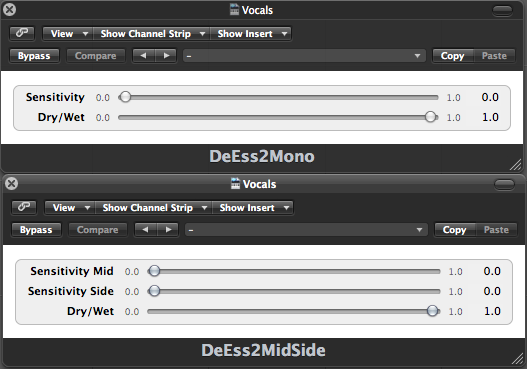
DeEss2

DeEss2Demo is the latest version of the very successful Airwindows de-esser! It’s refined for easier, more effective operation, and now comes in normal and mid/side versions by request!

NOTE: you can also have the original DeEss when buying this. It turned out that the original, confusing-to-operate DeEss had special tone qualities that this simplification took away. Check to see if you’d rather learn the original Airwindows DeEss, because I’ll send it to purchasers of DeEss2 who ask. And of course, you’ll get future DeEsses, if I manage to get best of both worlds in one plugin…

This is very much a mastering grade DeEsser. When not engaged and triggered, it does a strict hard bypass, doing no processing or anything beyond literally copying the input data right through to the output. When it is triggered, it applies a lowpass filter of a special kind, rather than just gating everything- that’s so it can be used on full mixes without disrupting them too badly. It also processes in 64-bit resolution, and noise shapes that output to the Audio Unit 32-bit output buss (like other recent Airwindows plugins). And of course, like all Airwindows plugins, it’s 64-bit compliant, while still working on 32-bit Intel and even 32-bit PPC Macs.

If you hear it affecting sung notes, it’s already way way past engaging on esses (it is designed properly, to not sound as if it’s doing anything while controlling esses). Set it so it takes the super-hot highs off only the esses, which MIGHT produce lispy effects and might not even go as far as to do that- and then, use the dry/wet control to bring back some of the ess for tonal purposes, while leaving it well controlled. These plugins are designed to work with bright tracks where the esses are a real problem, not meant to turn any old track into thoft thonic thculpture. I hope it finds uses in a few good places.

DeEss2 is $50.

PocketVerbs

PocketVerbsDemo is a universal binary Audio Unit plugin (64/32/PPC) for specialty reverbs! It offers a variety of verb types, both normal and strange, and permits gating and dynamic reverb levels based on signal intensity. Dual mono for bigger mix width!

This isn’t the ‘normal’ Airwindows reverb. That’s been developed over the years, through products like FarSpace, and is now sold under the name Space, and it’s a terrific and very believable stereo reverb.

This stuff is a little different.

PocketVerbs gives you a batch of little weird reverbs and effects. They can run in mono. They can run dual-mono, which has its own merits. You can throw ’em on vocals, on stereo synth tracks, you could use ’em as a main mix verb if that pleased you: maybe weirdness works better for your mix on the whole, maybe there’s just an element in there which could use something different.

Chamber is an airy, verby kind of space, a particular sort of artificial reverb flavor. Spring is another sort of algorithm that’s sproingier and might show you a dub sort of feel. Tiled is on the bright side, Room is much darker and more tightly tied to the raw sound, and then there’s the really weird ones: Stretch acts like a plugin Paulstretch only more edgy, and Zarathustra gives you huge ambient swells of distant sound (just run a horn through it and you’ll soon see why it got that name).

Then, on top of that, there’s the gating section, letting you trap the reverb effect in to the envelope of the original sound, or some variation on it. Instant drum thickness! This makes PocketVerbs instantly useful on individual drum tracks. You can totally redefine a mix element without muddying everything else.

You have to try it and see. None are really ‘good and correct’ digital reverbs. But they’re a very fun bag of tricks, six strikingly different tonalities in one, and then you bring in the gating… Who knows what evils lurk in the heart of PocketVerbs?

This is also the first product for which I ever made a video (and it shows!)

PocketVerbs is $50.

DigitalBlack2

DigitalBlack2 is meant to be the ultimate gate for djent or anything staccato.

It can be set up to be ridiculously fast and articulate, with separately settable attack and release thresholds. The reason you can have an ‘on’ threshold lower than the ‘off’ (or ‘gate’) point is, it runs internal timing like DigitalBlack anyway, so you can tell it to open with the on threshold and then it’ll immediately try to close.

While it’s running through its internal timing (which is sensitive to the frequencies passing through it, like DigitalBlack) it passes pure sound without shut-off artifacts. It will not sputter, and it’ll switch off more aggressively if it can (if it’s had mainly highs passing through).

It has to run through to either silence, or go above the off threshold, to stay open: the on threshold is like the ‘hair trigger’ to catch subtleties of attack, while the off threshold is the real gate threshold. Finally, the gate speed is adjustable on DigitalBlack2, on top of the frequency sensitivity: you scale the whole response up or down even though it’s already adaptive to the signal’s wavelengths.

It’s free.

DigitalBlack2 might not be the simplest gate to set, but I think it’s the most high-performance musical noise gate in existence if you can master it. There are more ‘hi-fi’ noise gates for mastering and mixing, but this one is for making things staccato in completely controllable fashion, and delivering sounds with unparalleled aggression. If it does that for you and you know others with similar needs, tell them. Because the thing is, if more people use a gate this good and this sensitive to human performance, it becomes all about your touch and muting. Why not show that off on equal footing?

Newer Posts
Older Posts

Airwindows

human-made bespoke digital audio

Kinds Of Things

The Last Year

Patreon Promo Club

altruistmusic.com

Dave Robertson and the Kiss List

Decibelia Nix

Gamma1734

GuitarTraveller

ivosight.com – courtesy Johnny Wishoff

Podigy Podcast Editing Service

Super Synthesis Eurorack Modules

Very Rich Bandcamp

If you’re pledging the equivalent of three or more plugins per year, I’ll happily link you on the sidebar, including a link to your music or project! Message me to ask.