Menu Sidebar
Menu

Chris

Hi! I've got a new plugin you can have! These plugins come in Mac AU, and Mac, Windows and Linux VST. They are state of the art sound, have no DRM, and have totally minimal generic interface so you focus on your sounds.

BussColors3

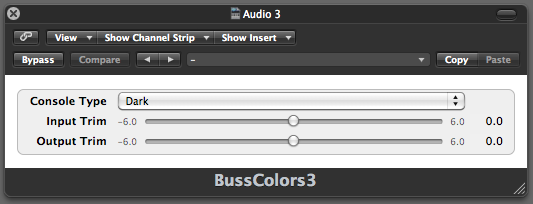
BussColors3Demo has eight models: Dark, Rock, Lush, Vibe, Holo, Punch, Steel and Tube. These originally came from sets of impulse responses by a guy at Noisevault, with his permission and blessing—over the years I’ve doctored the impulses until it’s algorithms building new impulses for every sample, on the fly. Because it runs on impulses, BussColors3 is intended to run at 44.1K (it will still run at any sample rate, but the sound will be different)

All of these come pre-calibrated to work as drop-in replacements for ConsoleChannel, if you run Console on your mix buss. That means not only can you have expanded soundstage depth, you can also have tone color much like the big-name ‘digital simulation’ companies—or better.

BUT.

The way the industry cannibalizes and trades on the reputations of classic hardware designers has started to piss me off, so I’m no longer providing the reference to what ‘brand’ these sounds refer to. If you gotta pirate illicit bit data, let it be the secret identities of what these sounds were. If you’re really good I see no reason why you wouldn’t just recognize them from the sound or description alone, that’s the important thing, right?

Dark acts like an old medium-format console, with unusual midrange articulation and a really solid sound when pushed. It’s a classic 70s sound.

Rock acts like that ‘post-70s hit record sound’. It’s a very big automated console with a particular gloss and sheen to it. Rock can be dialed in for maximum slam short of obvious breakup, using the input trim control.

Lush acts like a big lush large-format console, emphasis on big. It’s an alternate 70s hit record sound, more in the softrock vein- pillowy and fat, with airy highs and large in scale.

Vibe acts like some sort of funky old console, with a liquid organic sound but not as big-budget as Lush or Dark. Could bring an old dub platter sound to a track.

Holo brings a particular sort of three-dimensionality to the sound, and conveys a distinct soundstage where locations of sound sources take on a special holographic quality. Particularly if you run it with extra headroom it might suit classical work.

Punch is another classic rock console, with a gutsy rocking quality that’s loaded with punch and impact. Very recognizable if you have these pres.

Steel is a special effect console—it’s sort of lean and brings a distinct acidic, metallic quality to the sound. It could really accentuate the personality of some electronic/DnB/dubstep work. It cleans up lowmid mud and sounds aggressive, not mellow.

Tube finishes up the set, bringing an airy, electric quality like some of the oldest recording consoles out there. Only low-voltage starved-plate fake-tube designs are dull and rolled-off: real tubes bring a lot of energy and presence to a sound, and this one’s not shy with the highs. You can also use Tube in stereo to convert a ‘digital EQ’ into a much flashier emulated analog EQ. Put BussColors Tube first, then the EQ, then ConsoleBuss. You’ll get the hotrod fancy EQ sound and behavior, it’s ‘expanding’ the ordinary digital EQ calculations like they were a mix buss. It may change the calibrations…

BussColors3 is $50.
Console2

Console2Demo is the very latest in DAW large format analog console emulation- without the ‘tone color’ part, which is already being handled by Desk and BussColors. Does the idea of a ‘very latest’ without tone coloring surprise you? Console2 surprised me. Here’s the backstory.

I’ve been working in this area for some time, and one thing people always ask for is analog crosstalk. Sometimes the conversations got extremely technical and heavy, with trained electrical engineers trying to convince me of the significance of varying buss input impedances, which wouldn’t be a huge deal in a well-designed console so far as I know…

Following one such thought experiment out, I figured out that if this was happening, a channel would distort easier if it was looking into a buss that was out of phase with it, because other channels would present negative impedances and pull some of the energy that would’ve gone to the output. In normal DAWs (and normal DAWs are working DAWs- doing crazy things to their software is a recipe for trouble) you can’t have the channels talking to each other like that, plus it could produce extraordinary CPU demands.

But what if there was a way to make a channel come across more distorted if it was feeding an out of phase buss, and less distorted if everything was in phase? The experiment was this: pre-distort all the channels in a calibrated way (like traditional tape noise reduction systems), sum everything, and then undistort it- apply negative distortion.

Negative distortion? Sounds crazy, but Airwindows has had it for years- take the original Density plugin, and set it to negative settings. Presto, un-saturation, inverse distortion. It sounds terrible—all by itself—but it does have a way of pushing stuff like ambience into the far distance.

When you pre-distort everything, and then apply the calibrated un-distortion on the buss (that would sound bad by itself), what happens is that everything in phase sums and gets expanded back again and sounds just the same. (actually, there’s a bit of peak compressing but it doesn’t sound bad—mostly it sounds just the same). Anything that is going more out of phase with the buss it actually doesn’t see, will end up not as far along the waveform as it thinks it is, and will get less of the un-distortion, so it’ll have more distortion left over, just as if it was able to consult neighboring tracks and apply its distortion relative to what the buss input impedance was.

Sonically, what you get is, the actual sounds don’t seem particularly altered, but the space between the sounds gets hammered with the full ‘undistort’ treatment, which if you remember, has a trick of sounding very distant and thin all by itself. But we’re not talking about the sounds anymore- they’re pre-compensated- we’re talking about the sound of the buss itself at this point.

That can best be summed up as ‘wildly 3D, huge, articulate, spacious’… frankly, it shocked the hell out of me the first time I heard it, not to mention when I started A/Bing it against raw DAW summing. The pure math DAW summing was ridiculously flat by comparison. Even Desk (my previous best solution) was ridiculously flat, though a much better texture. Turned out that nothing I’d previously done had addressed this problem at all, and suddenly I’d targeted it exactly.

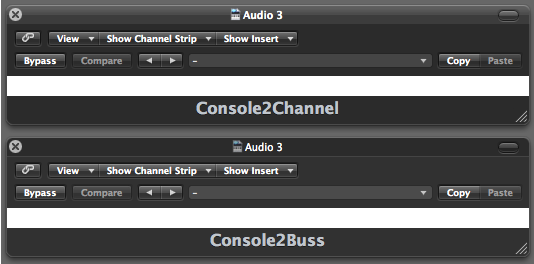
You have to use the Console2 plugins in sequence, like they were analog noise reduction or something. Console2Channel goes at the end of all channels feeding the 2-buss, and Console2Buss goes first on the buss, before anything else- with ONE exception, you can use the default setting of BussColors3 in front of it (or Desk3, or a third party buss tone coloration plugin, if you like) because this type of processing won’t throw off the calibration (it’s too subtle) and it is improved by the expansion of space within it. But anything like compressors, tape effects, should only happen after Console2Buss, when the sounds are back to their intended forms. And if you are using BussColors3 to ‘slam the buss’ by turning up input gain, you should put it after Console2Buss, not before.

If you’d like this, buy the most recent Console and ask me for the older version in email. I’ll send it to you :)

Iron Oxide 3

IronOxide3Demo added tape flutter to Iron Oxide, and tuned the antialiasing. This is much like ToTape: the basic concept of the plugin doesn’t change that much, though 3 added flutter and 4 added an inv/dry/wet mix control. These are the tape effects, not there to be radically reinvented each year.

If you like this one best, buy the current version and ask for this in email. I’ll send it.

BitGlitter

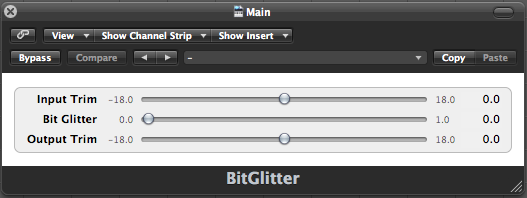
BitGlitterDemo started out as a universal binary AU plugin for emulating the sound of the classic Emu SP-1200 sampler, widely used in rap music—and then grew into kind of a monster.

People don’t always ‘get’ why you’d use an old digital device with limitations to the sound and frequency response, not to mention a 12 bit resolution, for fundamental parts of the mix. It seems crazy, but it’s not. Here’s what happens when you do that.

Primitive old digital (and for that matter, almost every shiny new digital plugin) produces aliasing—harmonics that bounce back off the top of the sampling rate and become added noise masking the sound. It’s very damaging for some purposes. It makes the sound more shallow, more opaque, and harder to focus on—seen in a lot of in-the-box mixes, especially before the advent of oversampling and antialiasing techniques.

It can also add solidness and opaqueness to the lows, throwing in aliasing that’s not brittle and high, but low and dissonant. The effect is a little like a low cluster on piano, jangly and with a lot of presence. When you apply this effect to, say, drums, it becomes more obvious why that is desirable. The drums (or the ‘beats’, which includes backing music built into the loops) get more punchy and solid.

The thing is, even this can be purposeful. If the whole production must have loud rhythm but focus attention on the vocal, one way to do that is wreck the beats with old sampling—letting them stay just as loud, hit more in the midrange, and make a lot of space for the vocal, which is typically not going to be bit-crushed (except for effect or something) and might even be doubled or cut with a very detailed, high-resolution mic. The contrast can be huge between the resolution of the beat and the resolution of the voice, allowing for very loud beats but total focus on the voice.

This slider can be automated, so it can do sweeps or flick to a specific spot for individual words or breaks. The barking or slammed stuff throws a lot of extra aliasing in, so it works like an accent and pops out of the mix without additional volume automation- then you can go back to near zero for the ‘vinyl-like’ straight sampler low-res sound. BitGlitter also has no latency, so it can be used live wherever you can use an AU. Bypass it to shut the low-res tone off. Very simple and effective :)

BitGlitter is $50.

Newer Posts
Older Posts

Airwindows

human-made bespoke digital audio

Kinds Of Things

The Last Year

Patreon Promo Club

altruistmusic.com

Dave Robertson and the Kiss List

Decibelia Nix

Gamma1734

GuitarTraveller

ivosight.com – courtesy Johnny Wishoff

Podigy Podcast Editing Service

Super Synthesis Eurorack Modules

Very Rich Bandcamp

If you’re pledging the equivalent of three or more plugins per year, I’ll happily link you on the sidebar, including a link to your music or project! Message me to ask.