Menu Sidebar
Menu

Chris

Hi! I've got a new plugin you can have! These plugins come in Mac AU, and Mac, Windows and Linux VST. They are state of the art sound, have no DRM, and have totally minimal generic interface so you focus on your sounds.

ADT

ADT was one of the first Airwindows plugins. It uses two adjustable delay taps, which you can mix either in-phase or out of phase, to sculpt the sound.

The idea is, you can get a lusher sound through the very quick delay while also positioning the times so that they give you reinforcements and cancellations in useful places. It’s possible to find tonal qualities and then cancel them out by reversing the phase of the tap.

There’s no demo for this, and a more recent version that’s still for sale (look for ADT2). If you’d like the older version of ADT from 2007 without the code from Console that makes it bigger and deeper, buy the current ADT and ask for this one by email. I’ll send it. Even though the plugin is from 2007, the compile of it is more recent and 64-bit friendly.

ADT declares one sample of latency (this was kind of a phase)
Snares

Snares is a glorious trainwreck! It’s very difficult to make work.

The idea is, you get the top and bottom of the drum sound. The top you can replace with white noise, and the bottom you can replace with brown noise. Sound good so far?

Here’s the trouble. You can’t just overlay white noise onto a snare, at least not sample-by-sample. It’s too lean and sputtery, you have to trigger a separate envelope (like Noise). And you can’t make brown noise just by a random walk! You have to make it with more sophistication (again, like Noise) so you can actually hear it and it’s in useful ranges. Otherwise, you just have a big splurt of DC offset, and your channel distorts horribly. Making the bottom end of Snares useless and very hard to control.

If you want what this WANTED to be, back in 2007, you need Noise which came out in 2014.

If you want a horrible trainwreck… have fun! Maybe you can get a useful noise out of this. I’m guessing ‘nope’ ;)

Snares declares one sample of latency.

Kicks

Kicks is… well. How do you get YOUR kicks? Probably not like this.

Kicks is…

while (nSampleFrames– > 0) { inputSample = *sourceP; sourceP += inNumChannels; tone += increment; if (tone > pie) tone -= pie; outputSample = (inputSample * (1.0-kicks)) + (inputSample * sin(tone) * kicks); *destP = outputSample; destP += inNumChannels; }

All this does, ALL it does, is overlay a tremolo onto the sound. Not even a fancy tremolo like the Airwindows tremolo, just a straight-up sine-shaped amplitude modulation at various bassy frequencies.

The idea was that you could break up a ringy kick by vibrating this other frequency across it. Of course, you risk stepping on the attack transient that way.

Whatever. At least you got to read the main event loop. :)

Kicks declares one sample of latency.

ResEQ

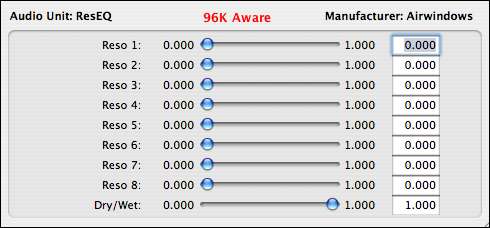
ResEQDemo is a universal binary AU plugin that gives you up to eight parallel resonant filters. It uses convolution modeling of an idealised analog-style peak impulse for extremely rich textures, and can do ‘parked wah’ effects of great sophistication.

The thing is, ResEQ builds a really complicated sort of ‘parked wah’ across a lot of frequencies, and doing that creates resonant (hence the name) tones that contain only those frequencies actively useful to you. It’s like going bonkers with a normal EQ or three and ripping everything that’s not useful. The result will sound very different from what you sent into the plug. You can use it on whatever, though it was designed around heavy guitar, particularly doubled or tripled heavy guitar where you might want additional thickness without screwing up other mix elements.

Note that effectively ResEQ gets rid of anything that will mask other instruments or get in the way in the mix—by centering on a whole bunch of different frequencies and discarding everything else, you can totally whack distortion-fizz no matter what the original tone sounds like. I’d suggest saving good settings as Logic presets, because it might take some time dialing them in, but with eight frequencies available you can have ‘secret guitar voicings’ as tricky to work out as a secret sauce. Try to find spaces in the frequency range to fill out the sound—some midrange, some up in the treble or supertreble, some down lower. The result will resemble a fullrange sound, but it will not mask other mix elements hardly at all.

ResEQ declares one sample of latency.

ResEQ is $50.

Newer Posts
Older Posts

Airwindows

human-made bespoke digital audio

Kinds Of Things

The Last Year

Patreon Promo Club

altruistmusic.com

Dave Robertson and the Kiss List

Decibelia Nix

Gamma1734

GuitarTraveller

ivosight.com – courtesy Johnny Wishoff

Podigy Podcast Editing Service

Super Synthesis Eurorack Modules

Very Rich Bandcamp

If you’re pledging the equivalent of three or more plugins per year, I’ll happily link you on the sidebar, including a link to your music or project! Message me to ask.