Menu Sidebar
Menu

Chris

Hi! I've got a new plugin you can have! These plugins come in Mac AU, and Mac, Windows and Linux VST. They are state of the art sound, have no DRM, and have totally minimal generic interface so you focus on your sounds.

Peak Limiter

Peak Limiter is the first Airwindows loudness plugin, and has a number of unique features. While these days I encourage people to not limit or distort, and to use ADClip for the cleanest possible handling of overs, and to get NC-17 if you’re looking to just do silly loudness… there have been other approaches from Airwindows in the past.

Peak Limiter has three controls: boost amount, corner frequency and distortion.

Boost amount is obvious, offering 12 db of gain on tap. Corner Frequency isn’t at all obvious—what it’s doing is, sending a highpassed signal to the boost and the peak limiter, and then passing through what’s under the cutoff straight to the output. The idea was that you could push loudness while still having sine basses or something, and have them combine without distorting the bass. It sort of worked… and then Distortion is exactly what it would appear to be. Plus, it’s tracking overshoots and chasing them with a Chebyshev filter much like what NC-17 does.

The whole thing works like this: splitting of frequencies to clean up the bass, compression kicking in to handle the added gain, second harmonic added to supplement the lows: merge to an output, apply the soft-clipping of Distortion and then hard-clip after that just to be sure.

If you’d like a copy of Peak Limiter, buy one of the Airwindows loudenation plugins (NC-17 or ADClip, which clips much better than Peak Limiter ever will) and email me. I’ll send it.
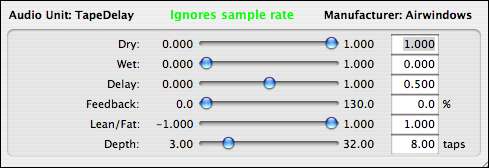
TapeFat

TapeFat is a little plugin that just does one thing: it’s variations on the tone stack inside the first Iron Oxide, and is the same sort of thing you get in Tape Delay. Works similarly to BrightAmbience in that settings with fewer taps take less CPU and do less processing. It’s based on prime numbered delay taps, too. Weighting the delay taps that way creates an EQ curve that’s like a twisted version of a moving average, so it’s several different kinds of not technically correct!

Consider it a glimpse into the very earliest days of Airwindows, and a curious little tone shaper that may not be amazing but is at least pretty unique. It sounds better in a tape delay plugin’s regeneration path because successive instances combine well thanks to the prime numbered delay taps. It’s free to play with in case you’d like to build larger Tape Delays out of DAW routing paths.

Tape Delay

TapeDelayDemo is a delay AU universal binary plugin. The delay return has a Tape Fat stage in series with the feedback. Will do ANY analog echo sound, even the ‘wub wub wub’ feedback of a Memory Man, or bright echo effects. Dub madness!

Tape Fat was like a primitive, tone-only variant of Iron Oxide, so Tape Delay uses what you might call the ‘tone stack’ of the early Iron Oxide. It’s not very sophisticated, but it will do crazy things, or even strange glitchy things, and it’s still for sale if you’re down with setting things manually.

Tape Delay is $50.

Bright Ambience

BrightAmbience is a weird little plugin from the early days of Airwindows. It’s got a dry/wet control, ‘sustain’ and ‘decay’.

Here’s how it works, since it’s not obvious.

It makes a ginormous delay buffer, and begins to fill the ‘wet’ buffer with ‘ambience’ which is simply a long series of delay taps. They are spaced out a bit, but they’re almost entirely just prime numbers.

If you have ‘decay’ as zero, all of them will be at full crank. If you increase ‘decay’ that’s one way of toning the ‘reverb tail’ down.

If you have ‘sustain’ as zero, the plugin will skip almost all but the very first delay taps. There’s no regeneration or anything sophisticated at all, it’s JUST a huge pile of prime-numbered delay taps in a row. As you increase sustain, the plugin includes more and more of them. Back in the day, you could bring a computer to its knees with this, crash it by slamming the thing to full crank (also your output gain would end up being very loud). Computers these days are more likely to handle it, but it’s still incredibly crude.

You can easily get a sick gated reverb effect through using no decay and just playing with sustain, or you can try to tone down the effect. Either way, the sound you get will bear little resemblance to any natural reverb, but it’ll contain loads of top end and a distinctive hissy quality that might find use in EDM. Since it’s based on prime numbers applied ‘raw’ as delay taps, there’s no coloration other than the very unnatural tone of the ambience itself, which is barely even like an ambience.

For those of you who will enjoy the heck out of this, have fun! Anyone who literally wants a plausible acoustic ambience, look elsewhere. Oh, also it’s N to N so on a stereo send it’ll fill in its ‘ambience’ directly behind any element in the sound image, melding with it. Definitely has uses, but you’ve got to know what you’re dealing with.

Newer Posts
Older Posts

Airwindows

human-made bespoke digital audio

Kinds Of Things

The Last Year

Patreon Promo Club

altruistmusic.com

Dave Robertson and the Kiss List

Decibelia Nix

Gamma1734

GuitarTraveller

ivosight.com – courtesy Johnny Wishoff

Podigy Podcast Editing Service

Super Synthesis Eurorack Modules

Very Rich Bandcamp

If you’re pledging the equivalent of three or more plugins per year, I’ll happily link you on the sidebar, including a link to your music or project! Message me to ask.